Santa Reindeer: A Sweet Handwritten Font for Handmade Charm
There’s that quiet moment—early morning light, coffee steaming, laptop open—when you’re designing a new batch of candle labels and nothing feels quite right. You’ve tried three script fonts already: one too formal, one too fussy, one missing that warm, approachable spark your lavender-vanilla soy candles deserve. Then you install Santa Reindeer, type “Hand-Poured • Small Batch,” and *yes*—that’s the one. It’s not just legible. It’s friendly. It’s inviting. It’s the kind of handwritten font that makes customers pause, smile, and reach for the jar.
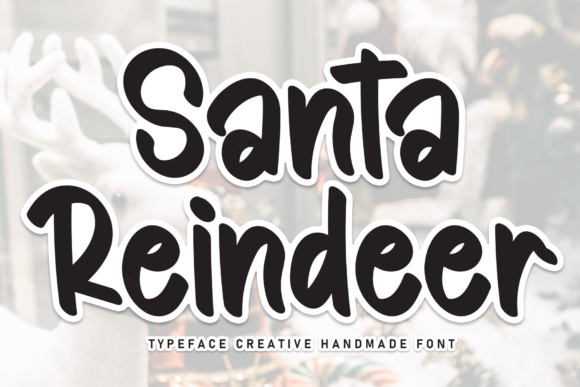
Santa Reindeer is a display font from Script Amp, crafted with soft curves, gentle slant, and subtle bounce—like ink drawn slowly with a flexible nib. It’s not overly ornate, but it’s never plain. The lowercase ‘g’ has a playful loop, the ‘y’ tails off with a relaxed flick, and capitals carry just enough personality to feel intentional without shouting. It’s cheerful but not childish, whimsical but not distracting—perfect for makers who want their typography to support, not overshadow, their handmade story.
I first used Santa Reindeer on a set of holiday gift tags—tiny 2”x3” kraft cards stamped with twine holes. At first, I worried the delicate joins might not cut cleanly on my Cricut, so I tested at 18pt on matte sticker paper. Crisp. No fraying. Even scaled down to 14pt for mini packaging stickers (think tea box seals or soap wrap accents), the letterforms held their warmth and clarity. For larger applications—like a farmhouse-style welcome sign for a friend’s backyard wedding—the font bloomed beautifully at 72pt, its natural rhythm guiding the eye across “Welcome to Our Love Story” like a gentle invitation.
What makes Santa Reindeer especially useful across handmade product categories is its sweet spot between readability and charm. It shines in short-form display use: product names (“Honey Lavender,” “Maple & Smoke”), boutique tags (“Made With Love • Portland, OR”), greeting card headlines (“You’re My Favorite Person”), and digital printable headers (planner weekly focus pages, baby shower banners, printable wall art quotes). It’s not designed for body text—but that’s exactly why it works so well as a *voice*: a consistent, recognizable tone across your shop’s visual language.
On physical goods, Santa Reindeer adds instant handmade credibility. Printed on cotton tote bags? It reads as thoughtful, not mass-produced. Embroidered (via digitized vector outlines) on linen napkins? It feels heirloom-soft. Silkscreened onto ceramic mugs? The rounded forms translate beautifully into tactile texture. Even in digital listings—Etsy thumbnails, Canva social posts, PDF preview images—the font’s warmth helps your product stand out in crowded feeds. Customers don’t just see “candle”—they sense care, craft, and connection.
For consistency, I pair Santa Reindeer with a clean, neutral sans serif—think Montserrat Light or Inter Regular—for supporting text: ingredients lists, care instructions, copyright lines, or fine print on invitations. That contrast lets Santa Reindeer breathe while keeping information scannable. When designing wedding stationery, I sometimes layer it over a quiet serif (like Playfair Display Italic) for envelope calligraphy previews—Santa Reindeer handles the couple’s names, the serif carries the date and venue. The result feels curated, not chaotic.
Before using Santa Reindeer commercially—whether on printed labels, SVG files for crafters, or editable Canva templates—I always check the license. Script Amp includes full commercial rights, but I double-check file formats (OTF and TTF included—great for both desktop design and cutting machines), glyph coverage (it supports basic Latin characters and common punctuation—perfect for English-language shop materials), and whether stylistic alternates or swashes are available (they are! A few charming uppercase variants add subtle variety to repeated uses like “Merry Christmas” banners). No multilingual expansion, so I avoid it for bilingual packaging—but for most U.S.-based handmade sellers, it’s more than sufficient.
Real-world testing taught me a few practical tips: For vinyl decals or iron-on transfers, stick to sizes above 16pt to preserve flow; for laser-printed greeting cards, use matte or uncoated stock to let the font’s soft edges feel organic, not pixelated. And when prepping digital downloads—say, a set of printable holiday planner stickers—I export the Santa Reindeer text as high-res PNGs with transparent backgrounds. That way, users can drag-and-drop into any app without font-installation hurdles.
It’s also become my go-to for seasonal shop branding refreshes. Last November, I updated my Etsy banner with “Cozy Season Starts Here” in Santa Reindeer, layered over a photo of frosted pine branches. The font’s gentle weight balanced the rustic imagery without competing—just like it does on my best-selling peppermint sugar scrub labels, where “Small Batch • Cold Processed” wraps softly around the jar’s curve.
What I love most isn’t just how Santa Reindeer looks—it’s how it *behaves*. It doesn’t demand attention; it earns it. It doesn’t shout “handmade”—it whispers it, warmly, consistently, across every label, card, tag, and download in my shop. In a world of algorithm-driven feeds and fast-scrolling buyers, that quiet authenticity matters. It tells people before they even read the description: *This was made with care. This was chosen with intention.*
If you’re selecting a script font for your next round of product design—whether you're printing 50 wedding menus or uploading your first digital sticker pack—give Santa Reindeer space to do what it does best: bring sweetness, sincerity, and handmade soul to every letter.